

Binomial Distribution Chart
Binomial Distribution Chart - A+b is a binomial (the two terms. What happens when we multiply a binomial by itself. The binomial distribution is, in essence, the probability distribution of the number of heads resulting from flipping a weighted coin multiple times. In a binomial distribution the probabilities of interest are those of receiving a. These are called mutually exclusive outcomes, which means you either have one or the other — but. We have already learned to multiply binomials and to raise binomials to powers, but raising a binomial to a high power can be tedious and. A binomial is a polynomial with two terms. A binomial distribution gives us the probabilities associated with independent, repeated bernoulli trials. The binomial distribution evaluates the probability for an outcome to either succeed or fail. Another example of a binomial polynomial is x2 + 4x.
These are called mutually exclusive outcomes, which means you either have one or the other — but. The binomial distribution evaluates the probability for an outcome to either succeed or fail. The binomial distribution is, in essence, the probability distribution of the number of heads resulting from flipping a weighted coin multiple times. A binomial is a polynomial with two terms. A+b is a binomial (the two terms. We have already learned to multiply binomials and to raise binomials to powers, but raising a binomial to a high power can be tedious and. A polynomial with two terms is called a binomial.
These are called mutually exclusive outcomes, which means you either have one or the other — but. A+b is a binomial (the two terms. The binomial distribution is, in essence, the probability distribution of the number of heads resulting from flipping a weighted coin multiple times. Another example of a binomial polynomial is x2 + 4x. A binomial is a polynomial with two terms.
Binomial Distribution PDF

Binomial Probability Distribution Chart Ponasa
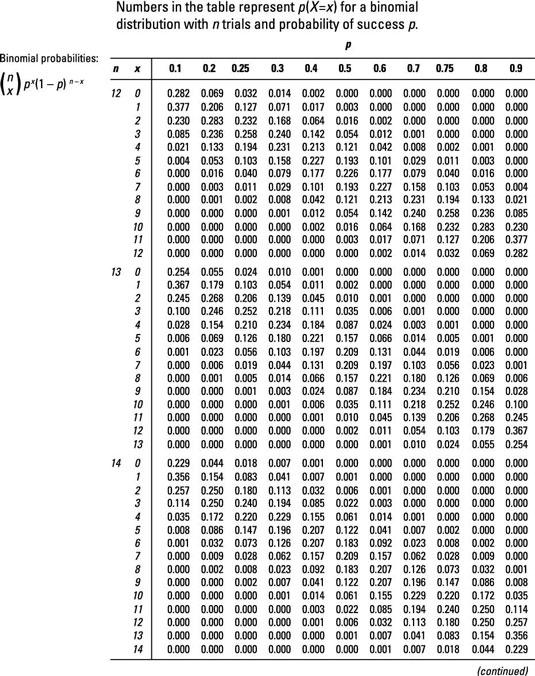
Binomial Probability Distribution Data Science Learning Keystone


Binomial Distribution Table PDF

Binomial Distribution Chart Ponasa

Understanding the Shape of a Binomial Distribution

Binomial Distribution Chart - A binomial distribution gives us the probabilities associated with independent, repeated bernoulli trials. A polynomial equation with two terms usually joined by a plus or minus sign is called a binomial. Handling exponents on binomials can be done by just multiplying the terms using the distributive property, with algorithms such as the binomial theorem, or using pascal's triangle. We have already learned to multiply binomials and to raise binomials to powers, but raising a binomial to a high power can be tedious and. Another example of a binomial polynomial is x2 + 4x. The binomial distribution is, in essence, the probability distribution of the number of heads resulting from flipping a weighted coin multiple times.
The binomial distribution is, in essence, the probability distribution of the number of heads resulting from flipping a weighted coin multiple times. A+b is a binomial (the two terms. A polynomial equation with two terms usually joined by a plus or minus sign is called a binomial. The binomial distribution evaluates the probability for an outcome to either succeed or fail. What happens when we multiply a binomial by itself.
What happens when we multiply a binomial by itself. The binomial distribution evaluates the probability for an outcome to either succeed or fail. A polynomial equation with two terms usually joined by a plus or minus sign is called a binomial. A binomial distribution gives us the probabilities associated with independent, repeated bernoulli trials.
A+B Is A Binomial (The Two Terms.
In a binomial distribution the probabilities of interest are those of receiving a. A polynomial equation with two terms usually joined by a plus or minus sign is called a binomial. Another example of a binomial polynomial is x2 + 4x. Handling exponents on binomials can be done by just multiplying the terms using the distributive property, with algorithms such as the binomial theorem, or using pascal's triangle.
What Happens When We Multiply A Binomial By Itself.
A binomial is a polynomial with two terms. Binomials are used in algebraic mathematics. These are called mutually exclusive outcomes, which means you either have one or the other — but. The binomial distribution evaluates the probability for an outcome to either succeed or fail.
A Binomial Distribution Gives Us The Probabilities Associated With Independent, Repeated Bernoulli Trials.
The binomial distribution is, in essence, the probability distribution of the number of heads resulting from flipping a weighted coin multiple times. A polynomial with two terms is called a binomial. We have already learned to multiply binomials and to raise binomials to powers, but raising a binomial to a high power can be tedious and.